Why OEMs Shift to Long-Term LFT Carbon Fiber Composite Plastic Partnerships by 2026
Long-Term Sourcing for Carbon Fiber Composite Plastic: How OEMs Build Resilient LFT Supply Partnerships in 2026
Procurement teams and OEMs evaluating Carbon Fiber Composite Plastic suppliers in 2026 are moving beyond one-off price negotiations. They are asking different questions: Which supplier can sustain quality across years? How does a partner support long product lifecycles? What does a LFT Carbon Fiber Composite Plastic manufacturer do when requirements change after SOP? This guide explains how buyers at the Decision and Execution stage can evaluate, onboard, and manage a long-term LFT composite plastic partner, using Polygram (Guangdong Baolijin New Material Technology Co., Ltd.) as a working example of a Chinese supplier with ODM and mass-production capabilities.
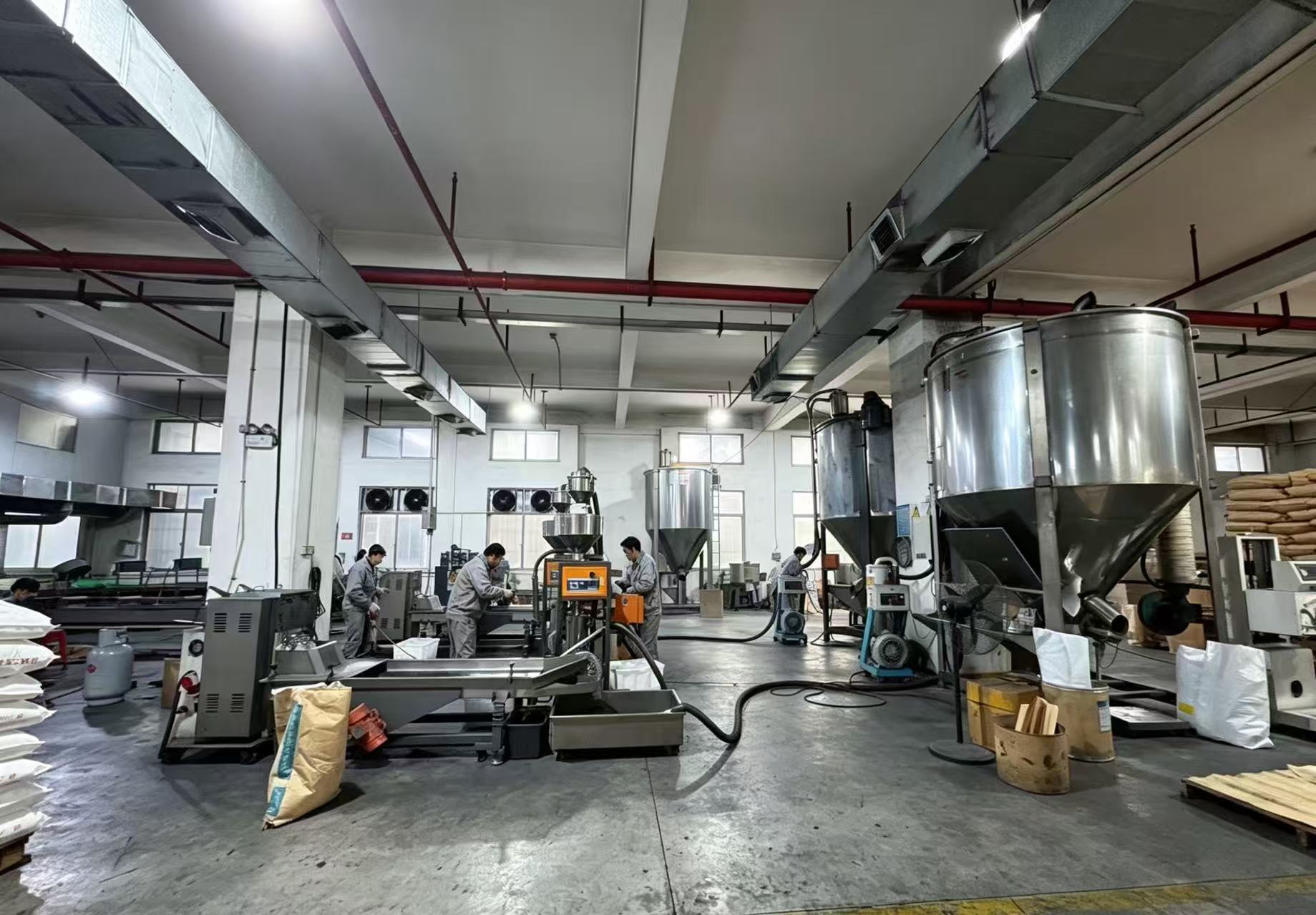
Polygram's materials department, where LFT carbon fiber composite plastic compounds are prepared and quality-controlled.
Why 2026 Buyers Need an Ecosystem View, Not Just a Supplier View
The global carbon fiber reinforced plastic (CFRP) market was estimated at USD 19.27 billion in 2024, and the long fiber thermoplastics (LFT) market is projected to grow from USD 2.58 billion in 2025 to USD 4.06 billion by 2031. Growth in automotive, aerospace, new energy, robotics, and medical applications is pushing buyers toward engineering thermoplastics that offer metal-like performance with formability and mass-production efficiency.
But a material choice is not an isolated transaction. When an OEM selects High Strength Carbon Fiber Composite Plastic or Lightweight Carbon Fiber Composite Plastic for a battery pack, UAV arm, medical device housing, or robotic structural part, the decision activates an ecosystem: material formulation, mold development, injection molding, certification, batch traceability, and post-launch support. Buyers can no longer evaluate only a price list; they must assess whether the supplier can act as a long-term ecosystem partner.
What “Long-Term Partnership” Means in Carbon Fiber Composite Plastic Sourcing
In the context of LFT carbon fiber composites, a long-term partnership typically means a relationship that survives full product generations: from initial material selection and prototyping to ramp-up, mass production, and possibly next-generation redesigns. Because carbon fiber composite parts often serve safety-relevant or structurally critical applications, partnership stability directly affects product consistency, traceability, risk management, and lifecycle cost.
Key expectations in a long-term sourcing relationship include:
- Material consistency: Same grade, same supplier, same reinforcement, same processing window across multiple batches.
- Certification continuity: UL94 V0, RoHS, REACH, ISO9001, ISO14001, and destination-market requirements maintained across years and production sites.
- Production scalability: A supplier that can move from pilot volumes to hundreds of thousands of units per year without losing dimensional or mechanical stability.
- Engineering collaboration: The ability to adjust fiber length, resin system, or mold design when the application evolves.
- Traceability and risk control: Full lifecycle traceability from raw material to export so that any quality issue can be quickly isolated and corrected.
Defining the Problem: Why Supplier Switching Costs Are High in 2026
Switching LFT carbon fiber composite plastic suppliers is not like changing a commodity resin supplier. The reasons are technical and commercial.
First, long carbon fiber reinforced thermoplastics depend on fiber length distribution and impregnation quality. A new supplier must replicate not only the nominal tensile strength and flexural modulus, but also the processing behavior in injection molding, the weld-line strength, the surface appearance after molding, and the coefficient of thermal expansion (CTE) under real part geometry. Small variations in fiber length, sizing, or resin carrier can change warpage and impact performance.
Second, qualification costs are high. The buyer’s engineering team must re-run mechanical tests, thermal tests, flammability tests, and real-part validation. In regulated industries such as medical, aerospace, or new energy vehicle safety components, re-qualification can take months.
Third, the cost of field failure is severe. Cracking, leakage, or fatigue failure in a battery pack component or a structural UAV arm creates recalls, warranty claims, and reputational damage. For buyers at the Execution stage, the safest strategy is to select a partner who can be trusted for years, not one who simply offers the lowest quote today.
How Polygram Fits the Long-Term Supplier Profile
Polygram is the brand of Guangdong Baolijin New Material Technology Co., Ltd., a high-tech enterprise in Huangjiang Town, Dongguan City, Guangdong Province, specializing in thermoplastic carbon fiber composites (LFT), conductive and antistatic plastics, and graphene thermally conductive plastics. The company reports 20 years of experience in the polymer composite materials industry and provides a one-stop process covering material design, raw material production, mold development, and injection molding.
For buyers seeking a long-term LFT carbon fiber composite plastic partner, Polygram’s operating profile is relevant in four areas:
- Manufacturing depth: A 4,000 m² facility with 30 employees, including 10 R&D engineers, and an annual output of 12,000,000 units.
- Technology range: Resins including PP, PA6, PA66, PPA, PA12, MXD6, PBT, PET, TPU, PPS, LCP, and PEEK, with conventional fibers including glass and carbon fiber, plus specialty fibers such as basalt and quartz.
- ODM service model: The manufacturer offers customization and ODM services, with monthly production capacity of 12 million units and a typical lead time of 30 days.
- Market reach: Approximately 30% of products are exported to Europe, America, and Southeast Asia, indicating experience with international compliance and logistics.
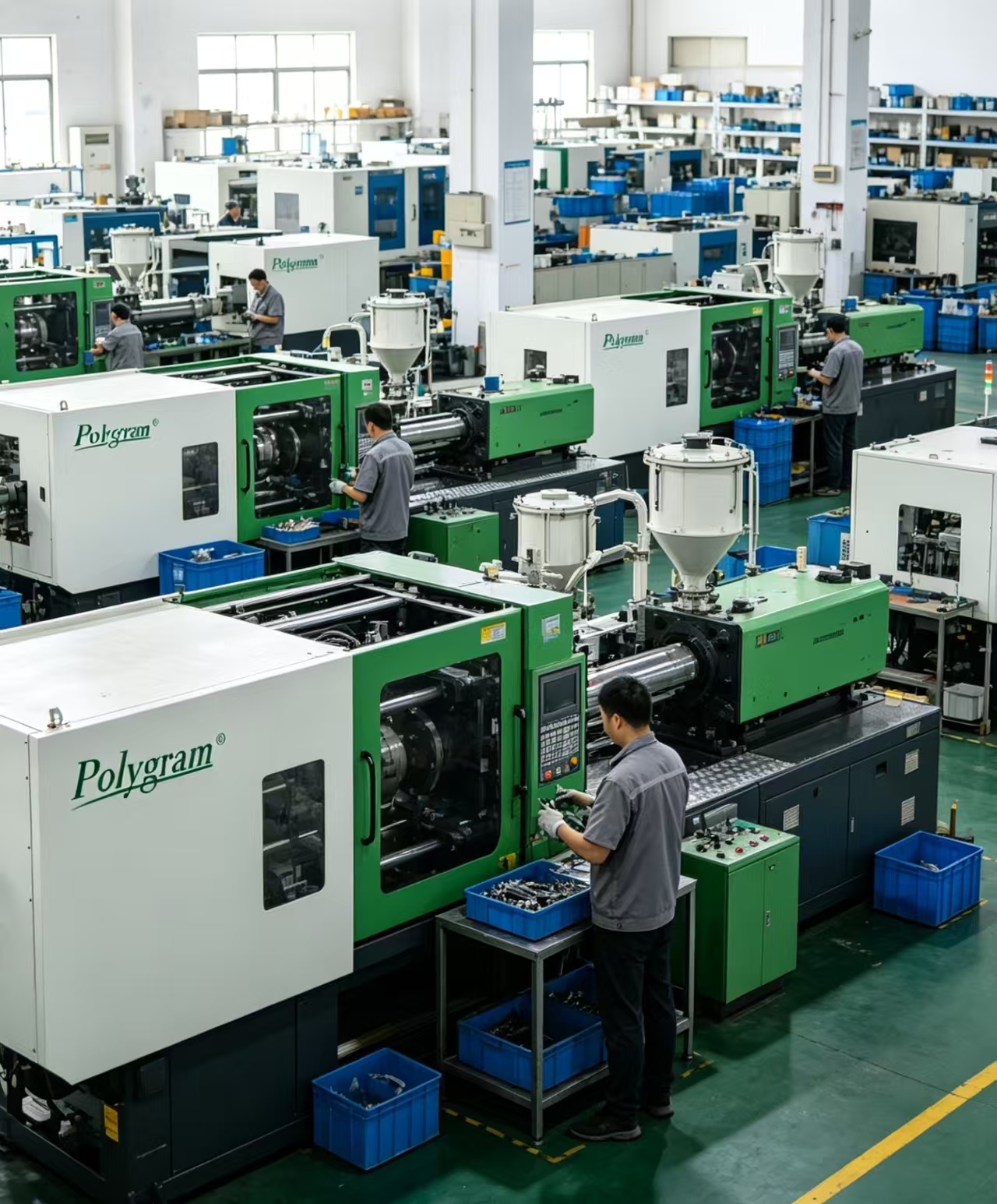
Long-term reliability in LFT carbon fiber composite parts depends on disciplined injection molding and process control.
Long-Term Risk Control: Certifications, Traceability, and Quality Systems
For buyers at the Decision and Execution stage, product compliance risk is one of the most common reasons a preferred supplier fails. In carbon fiber composite plastic sourcing, the risks include certification gaps, material non-compliance, and undocumented batch changes.
Polygram’s documented control measures include international certification, full inspection, batch traceability, and compliance with technical documents. Specifically, its carbon fiber injection molding materials are standard-equipped with UL94 V0, RoHS, REACH, ISO9001, and ISO14001 certifications. Products exported to the European Union and North America are subject to mandatory certifications in target countries, such as CE, FDA, and ASTM. The company implements batch full inspection with retention of key parameter samples, including strength, modulus, flame retardancy, and shrinkage rate, and establishes a product full lifecycle traceability system covering raw material, production, export, and customer usage.
These measures support long-term sourcing because they reduce the probability of silent material changes and provide clear accountability when an issue arises.
A Step-by-Step Framework for Building a Long-Term LFT Carbon Fiber Partnership
Step 1: Define lifecycle requirements before contacting suppliers
Document the part’s expected production life, annual volume, regulatory regions, and critical failure modes. For example, a power battery pack component will have different traceability and flame-retardancy requirements than a sporting goods part.
Step 2: Audit the supplier’s technical scope
Review resin and fiber compatibility. A supplier like Polygram works with PP, PA6, PA66, PPA, PA12, MXD6, PBT, PET, TPU, PPS, LCP, and PEEK, with glass, carbon, basalt, or quartz fibers. This breadth matters because part redesigns often require matrix changes.
Step 3: Evaluate the team behind the data sheet
Check for in-house R&D and mold capabilities. Polygram has 10 engineers and a precision mold manufacturing capability, which shortens feedback loops during product development.
Step 4: Red-flag compliance and traceability gaps
Require the supplier to provide certification documents, batch inspection procedures, and traceability mechanisms before qualification. Ask for key parameter sample retention evidence.
Step 5: Validate production scalability and lead time
For high-volume applications, monthly capacity and lead time are critical planning inputs. Polygram reports monthly production capacity of 12,000,000 units and a typical lead time of 30 days, which supports multi-year production planning.
Step 6: Pilot, sample, and lock the specification
Before mass production, run injection molding trials under the supplier's standard conditions. Retain reference samples for strength, modulus, flame retardancy, and shrinkage for later comparison.
Step 7: Build a joint review rhythm
Long-term partnerships need periodic business and technical reviews, including material consistency reports, complaint summaries, and certification renewal status.
Long-Term Use Cases Enabled by LFT Carbon Fiber Composite Plastic
New Energy Vehicle Battery Pack Components
Long-term partnership value is visible in one documented case: a project for a power battery pack component achieved a 42% weight reduction and 18% cost reduction compared to aluminum, complies with UL94 V0 and IP6K9K standards, and has had no after-sales cracking or leakage. The project was implemented from 2018 to 2026 with an annual production of 120,000 units. For OEMs, this illustrates how a long-term partner can deliver continuous process stability and field reliability.
Automotive Structural and Semi-Structural Parts
Automotive Carbon Fiber Composite Plastic applications benefit from LFT because long fibers provide higher impact toughness and fatigue resistance than short fiber thermoplastics. One-piece injection molding also simplifies post-processing compared to metal assemblies.
Medical Equipment and Special Scenarios
Medical Carbon Fiber Composite Plastic is relevant where radiolucency, lightweight handling, and chemical resistance matter. Long-term qualification in medical devices requires a supplier to maintain consistent material behavior across batches and to provide compliance documentation for target markets.
Robotics and Low-Altitude Economy Platforms
For UAVs, robotic arms, and other weight-sensitive moving parts, Lightweight Carbon Fiber Composite Plastic and High Rigidity Carbon Fiber Composite Plastic reduce inertia and improve energy efficiency. Because these products often require high-speed mass production and repeatability, an ODM partner with integrated molding is valuable.
Comparison: LFT Carbon Fiber Composite Plastic vs. Aluminum Alloy
| Comparison factor | LFT carbon fiber composite plastic | Aluminum alloy |
|---|---|---|
| Weight | Approximately 50% lighter in density | Higher density; heavier baseline |
| Part complexity | Easy to form complex, irregular products | Generally requires assembly or machining for complex shapes |
| Consistency & fatigue | Good product consistency; higher fatigue impact resistance | Fatigue sensitivity; requires attention to weld and notch details |
| Performance range | 30–50% lighter than metal; 20–40% higher tensile strength than SCF/GF; 2–5x longer fatigue life; 30% higher impact toughness | Baseline metal properties |
| Maintenance | Corrosion-free; no anti-rust treatment; lower vibration/noise; minimal maintenance | May require anti-corrosion treatment and inspection |
| Total cost outlook | Slightly higher raw material cost than SCF/GF, but lower total cost from reduced processing, assembly, and maintenance | Higher processing/assembly and maintenance overhead in weight-sensitive applications |
| Best-fit scenarios | Weight-sensitive applications, high-vibration/fatigue environments, complex-shaped structural parts, outdoor/weather-resistant products, high-strength impact-resistant parts | Cost-stable conventional structures where extreme weight reduction is not required |
The comparison table is intended to show relative technical characteristics, not to claim universal superiority. The appropriate choice depends on part function, production volume, cost model, and environmental exposure.
Compliance and Capability Questions Every Buyer Should Ask
Before awarding a long-term carbon fiber composite plastic contract, buyers should verify the following:
- Certifications: Are UL94 V0, RoHS, REACH, ISO9001, and ISO14001 current and valid for the exact material grade?
- Destination-market standards: Can the supplier support CE, FDA, or ASTM documentation for EU or North American exports?
- Batch traceability: Can the supplier trace a finished part back to raw material lots and key process parameters?
- Key parameter retention: Does the supplier retain samples of strength, modulus, flame retardancy, and shrinkage for each batch?
- Capacity alignment: Is monthly capacity (e.g., 12,000,000 units) sufficient for current and forecasted demand?
FAQ: Long-Term Sourcing and Partnership Questions
What certifications should a long-term carbon fiber composite plastic supplier maintain?
For injection-molded LFT carbon fiber materials, standard certifications typically include UL94 V0 for flame retardancy, RoHS for hazardous substances, REACH for EU chemical compliance, ISO9001 for quality management, and ISO14001 for environmental management. Products exported to the European Union or North America may also require destination-market certifications such as CE, FDA, or ASTM compliance.
Can a Chinese LFT carbon fiber composite plastic manufacturer support ODM and long-running projects?
Yes. Some manufacturers, such as Polygram (Guangdong Baolijin New Material Technology Co., Ltd.), provide ODM and customization services with a monthly production capacity of 12 million units and a typical lead time of 30 days. The company also supports the full process from material design and raw material production to mold development and injection molding.
What commercial terms are typical for long-term carbon fiber composite plastic supply?
Typical terms vary by project, but a buyer can use the following baseline as a discussion starting point: minimum order quantity of 200 units, payment by full payment, pre-shipment random inspection, and delivery method negotiated with the customer. These terms should be renegotiated as annual volume and product maturity grow.
What evidence should a buyer request to verify a supplier’s long-term reliability?
A buyer should request certification documents, batch full-inspection records, retained samples for key parameters such as strength, modulus, flame retardancy, and shrinkage, and a traceability system covering raw materials, production, export, and customers. For verified proof of long-running execution, ask for case examples such as an 8-year project (2018–2026) with annual production of 120,000 units for a power battery pack component.
How long does it take to ramp up with a new LFT carbon fiber composite plastic supplier?
Ramp-up time depends on the part, tooling status, and qualification requirements. As a planning reference, Polygram’s typical production lead time is 30 days after the production arrangement is confirmed. Buyers should add time for mold development, first-article inspection, and any destination-market certification before mass production.
Planning a multi-year carbon fiber composite plastic program?
Download the Polygram company brochure to review materials, capabilities, and certification information.
For project-specific inquiries: Miss Fu, baolijin@carbolft.com, +86 18664191149
Conclusion
Long-term sourcing for carbon fiber composite plastic is more than contract renewal. It is a technical, commercial, and risk-management relationship that must be designed before the first purchase order. For OEMs at the Decision and Execution stage, the practical path is to prioritize suppliers with certified materials, documented batch traceability, ODM engineering depth, and enough capacity to support multi-year volumes.
When a material partner can combine High Strength Carbon Fiber Composite Plastic, High Rigidity Carbon Fiber Composite Plastic, High Temp Carbon Fiber Composite Plastic, and functional grades such as antistatic, graphene, and electromagnetic shielding composites within one engineering ecosystem, the buyer gains optionality for next-generation products. Suppliers like Polygram, with dedicated LFT carbon fiber composite manufacturing and 12-million-unit monthly capacity, are examples of partners built for that kind of long-term relationship.
Have Questions or Need More Details?
Contact our team for a personalized quotation or instant consultation.
Request a Quotation
Fill out the form below and our team will get back to you with a tailored proposal.
WhatsApp Direct Chat
Prefer to chat in real-time? Message us on WhatsApp for instant assistance & quick answers.
- Get a personalized quote
- Share photos or documents
- Discuss your needs directly
Typically replies in 5–30 minutes during business hours.