
How to Select Carbon Fiber Composite Plastic for New Energy Vehicle Components: A Practical Guide
How to Select Carbon Fiber Composite Plastic for New Energy Vehicle Components: A Practical Guide
Selecting a carbon fiber composite plastic for a new energy vehicle (NEV) component is a specification exercise, not a brand exercise. The grade has to satisfy a defined load case, survive the thermal and chemical environment inside the vehicle, pass automotive compliance, and still mold reliably at production volume. This guide walks engineering and sourcing teams through that decision in eight structured steps, using the published LFT material data of Polygram carbon fiber composite plastic as a worked example.
Problem Definition: Why NEV Component Selection Is Harder Than It Looks
An NEV component is rarely governed by a single property. A battery pack upper cover must provide high-voltage insulation, resist electrolyte contact, absorb shock, hold its shape across thermal cycling, and remain dimensionally compatible with the aluminum structure it is bolted to. A structural bracket must carry bending load, resist vibration, and stay stable over service life. One material grade has to satisfy all of those constraints at once, while remaining moldable at the volumes an NEV platform requires.
Four specification errors appear repeatedly when engineers move from awareness of carbon fiber composites to an actual grade decision:
- Selecting on one headline number. Tensile strength alone says little about a plate-like part that fails in bending or in impact. Flexural strength, flexural modulus and impact resistance usually decide whether a cover or shield survives validation, not tensile data.
- Ignoring thermal expansion mismatch. When a composite component is fastened to an aluminum structure, a wide coefficient of thermal expansion (CTE) gap concentrates stress at fasteners and interfaces. Over thousands of thermal cycles, that stress shows up as cracking or leakage.
- Treating carbon fiber composite plastic as one material. Fiber length, fiber loading and the base resin change the grade substantially. Ordinary short fiber reinforced thermoplastics use fibers below 12 mm, while the LFT process produces fibers of 5 to 25 mm, and long carbon fiber loading can range from 20% to 60% in an LFT-G grade.
- Designing a material that cannot be molded at volume. A grade that cannot be injection molded with consistent fiber distribution will fail on the production line rather than in the laboratory.
To keep the discussion concrete, this guide uses a single published benchmark throughout: the material data for Polygram carbon fiber composite plastic, which reports a tensile strength of 350 MPa (ISO 527-2), a flexural modulus of 30,700 MPa and a flexural strength of 510 MPa (ISO 178), an Izod impact of 40 kJ/m² (GB/T 1843), an elongation at break of 7.8% (ISO 527-2), and a density of 1.28.
Industry Background: Why LFT Carbon Fiber Composite Plastic Is Being Specified Now
Carbon fiber composite plastic is moving from niche aerospace applications into mainstream vehicle engineering, and the market data reflects that shift. Grand View Research estimated the global carbon fiber reinforced plastic (CFRP) market at USD 19.27 billion in 2024. Within that space, MarketsandMarkets projects the long fiber thermoplastics (LFT) market to grow from USD 2.58 billion in 2025 to USD 4.06 billion by 2031. A parallel signal comes from functional composites: the electromagnetic shielding (EMI) composites market reached USD 1.97 billion in 2024, with a projected CAGR of 7.1% through 2033.
The commercial driver is weight. Electrified platforms carry battery mass that combustion platforms do not, so every kilogram removed from pack housings, covers, closures and structural brackets returns usable range. This is the reason LFT carbon fiber composite plastic is specified in weight-sensitive positions rather than used as a general-purpose material.
Two technical properties of thermoplastics support that specification. First, the LFT process impregnates long fibers with resin through a special mold system to produce long strips that are fully impregnated, which are then cut to the required length; the resulting material can be injection molded, extruded or molded, and can be used directly to replace steel and thermoset parts. Second, mechanical claims can be verified against established methods: tensile properties are commonly measured under ISO 527-4/5, and continuous filament tow properties under ASTM D4018, so a buyer can compare data sheets on equal terms.
Detailed Solution: How LFT Carbon Fiber Composite Plastic Meets NEV Requirements
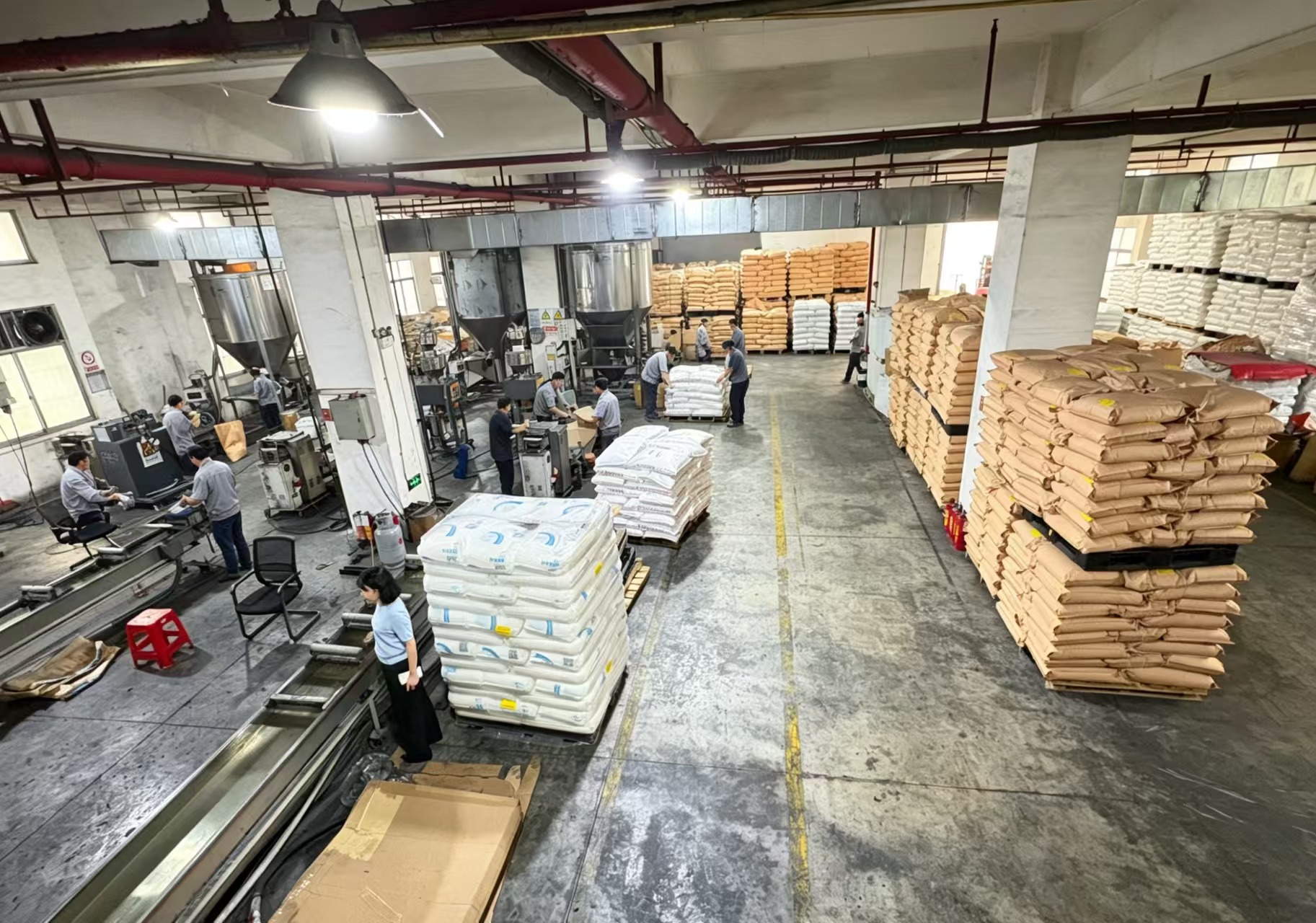
Polygram is the brand of Guangdong Baolijin New Material Technology Co., Ltd., a high-tech manufacturer headquartered in Huangjiang Town, Dongguan City, Guangdong Province, China, founded in 2017. The company researches, develops and produces thermoplastic (LFT) carbon fiber composites, conductive and antistatic plastics, and graphene thermally conductive plastics, and supplies high-end industries including aerospace, military, new energy vehicles, the low-altitude economy, robotics, semiconductors and sporting goods.
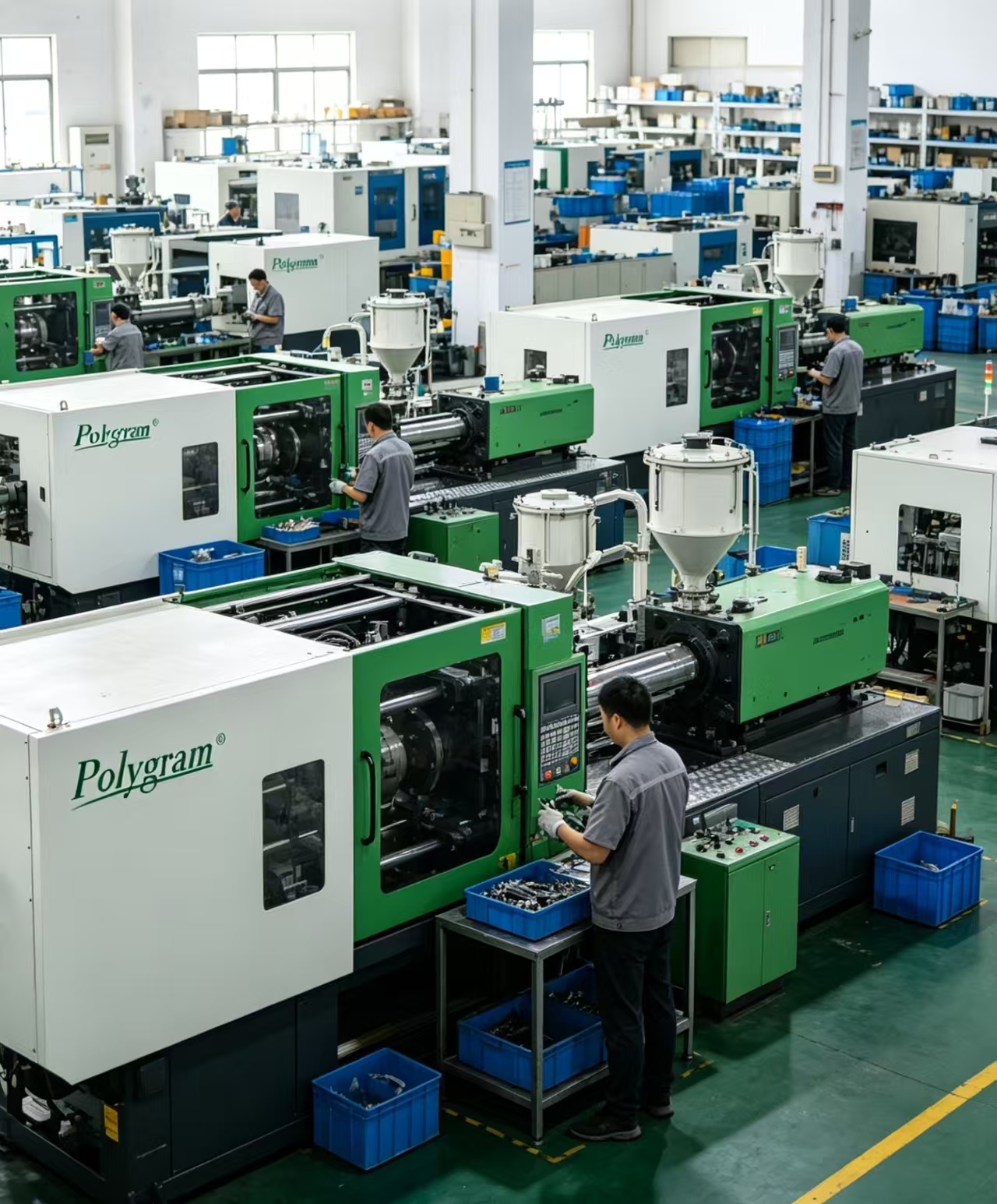
The production base covers 4,000 m² and is operated by 30 employees, including a 10-engineer R&D team, with an annual output of 12,000,000 units and approximately 30% of output exported to markets in Europe, America and Southeast Asia. The company provides a one-stop service covering material design, raw material production, mold development and injection molding, which is the practical reason a single supplier can carry a material grade from data sheet to validated part.
What the material actually is
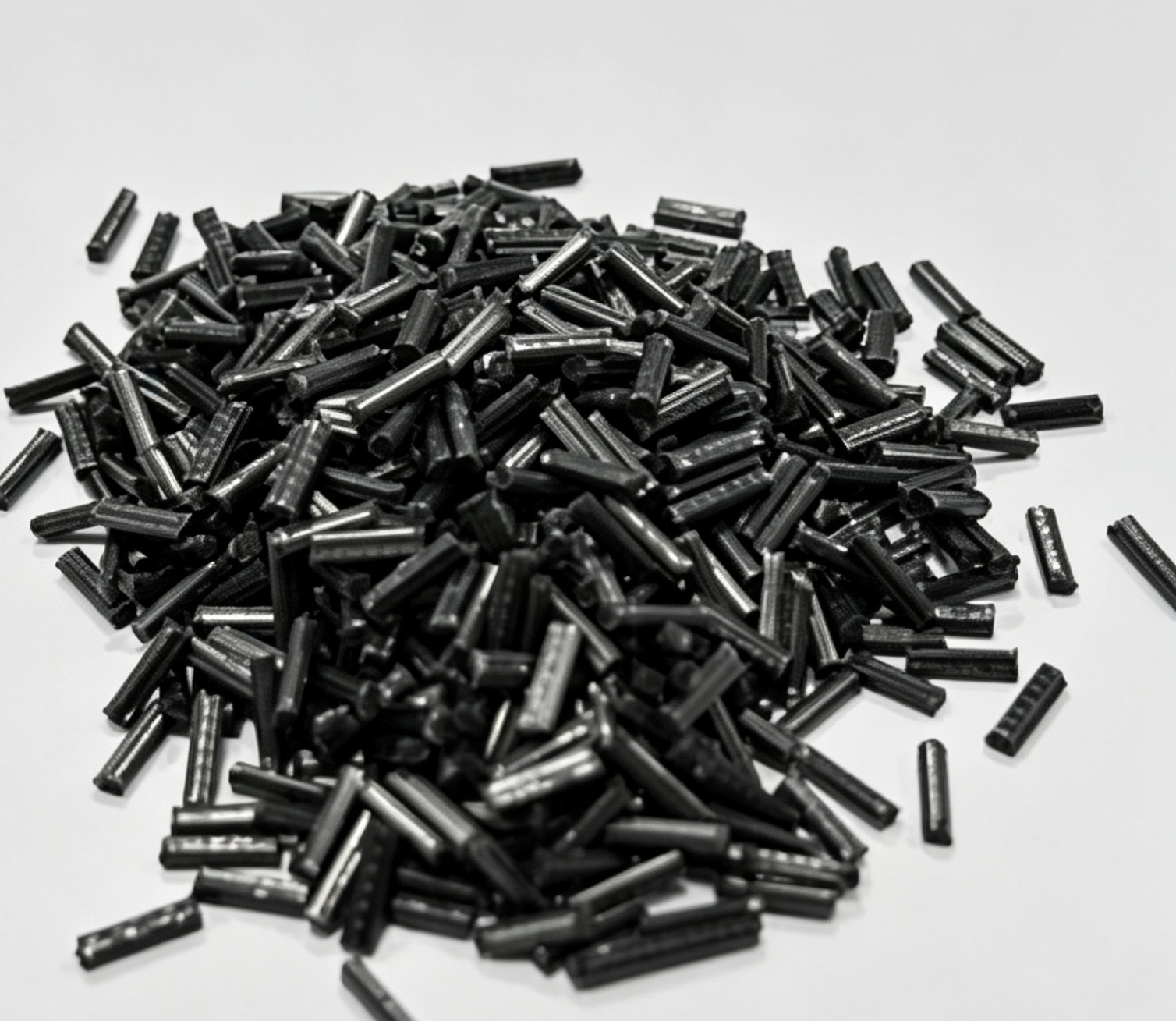
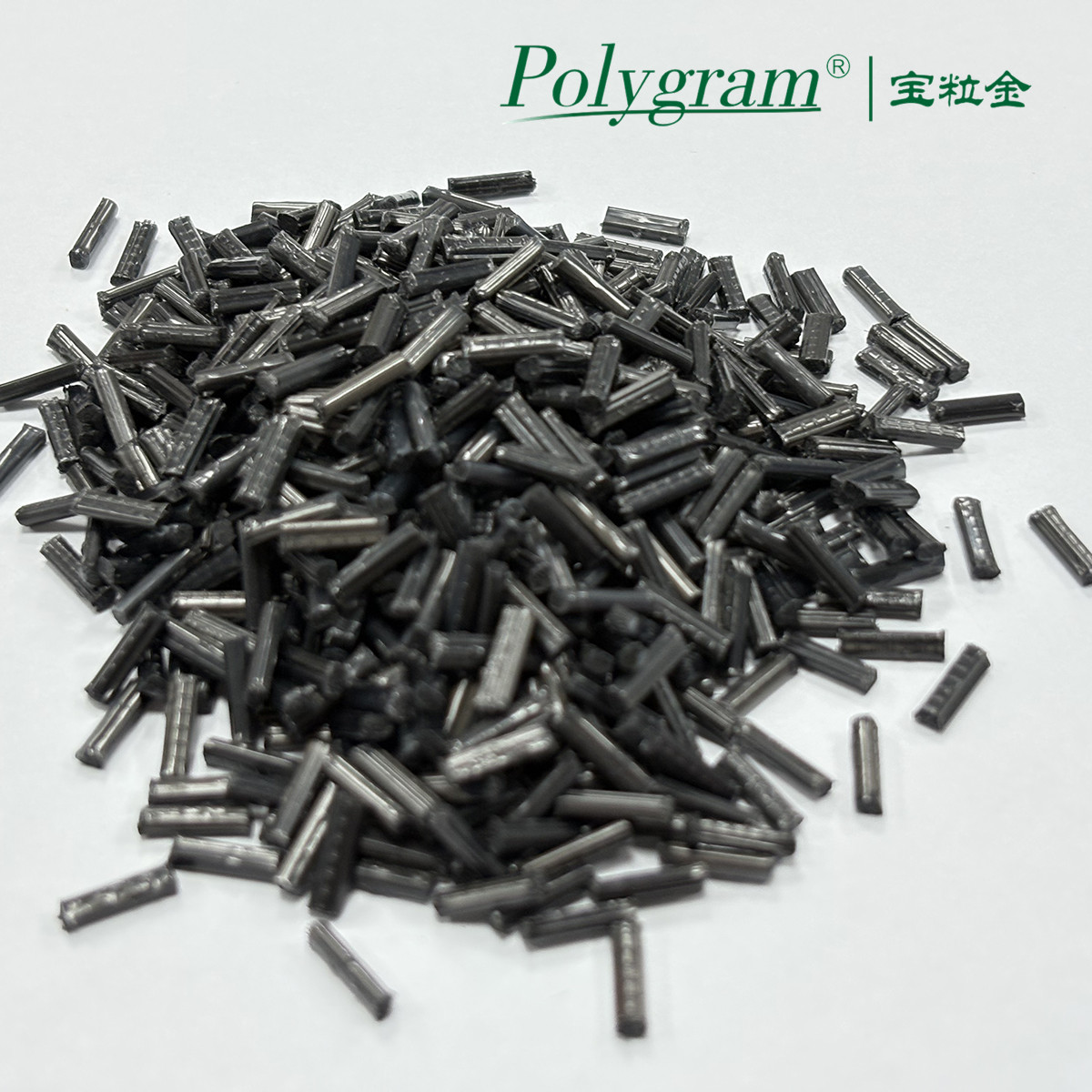
In the LFT process, long fibers are impregnated with resin through a special mold system to obtain long strips that are fully impregnated, and these strips are then cut to the required length. Fibers in this process measure 5 to 25 mm, compared with below 12 mm for ordinary short fiber reinforced thermoplastics. The LFT-G grade supplied by Polygram is black, made of 20-60% long carbon fiber, and is characterized as high strength, high toughness and durable; packaging is 20-25 kg per bag and can be customized.
Because the matrix resin can be varied, the LFT process is compatible with a range of base resins: PP is the most frequently used, followed by PA6, PA66, PPA, PA12, MXD6, PBT, PET, TPU, PPS, LCP and PEEK. Conventional reinforcement fibers include glass fiber and carbon fiber, while special fibers include basalt fiber and quartz fiber. Matrix and reinforcement selection is therefore an engineering decision tied to the operating temperature, chemical exposure and mechanical duty of the specific NEV component, not a fixed package.
Published material data for grade selection
The following values are the verified data points a component engineer can compare against a load case before requesting a sample.
| Property | Test standard / unit | Polygram LFT carbon fiber composite plastic | Why it matters on an NEV component |
|---|---|---|---|
| Density | Material data sheet | 1.28 | Baseline for weight-sensitive designs where an aluminum or steel assembly is being replaced |
| Tensile strength | ISO 527-2, MPa | 350 | In-plane load capacity for brackets, covers and housings |
| Flexural modulus | ISO 178, MPa | 30,700 | Controls deflection and stiffness under static and vibration load |
| Flexural strength | ISO 178, MPa | 510 | Bending is the dominant failure mode in plate-like parts such as pack covers |
| Elongation at break | ISO 527-2, % | 7.8 | Indicates how much deformation the part tolerates before fracture |
| Izod impact | GB/T 1843, kJ/m² | 40 | Impact tolerance for road-induced shock, handling and assembly |
| Long carbon fiber content | LFT-G grade specification | 20-60% | Reinforcement level can be matched to the load case instead of over-specified |
| Fiber length in the process | LFT process | 5-25 mm (short fiber comparison: below 12 mm) | Longer fibers improve load transfer between fiber and resin |
| Form and packaging | LFT-G grade | Black long strips cut to length; 20-25 kg/bag, customizable | Feeds directly into injection molding equipment |
Step-by-Step Breakdown: Eight Steps to Selecting the Right Grade
Step 1 - Define the load case and the failure mode
Start from the failure mode the component must avoid, not from a general desire for strength. A pack cover loaded in bending needs flexural data; a mounting bracket in tension needs tensile data; a shield exposed to stone impact needs impact data. The relevant values above (350 MPa tensile, 510 MPa flexural, 40 kJ/m² impact) should be read against that specific mode.
Step 2 - Fix the thermal and chemical environment
Document the maximum service temperature, the thermal cycling range, and every chemical the part will contact, including electrolyte and coolant. Where the composite bolts to aluminum, thermal expansion compatibility must be treated as a design requirement rather than a secondary detail: in the Polygram battery pack project described later in this guide, the material was specified with a CTE of 28 ppm/℃, compatible with aluminum.
Step 3 - Set mechanical targets and check them against published data
Translate the load case into required tensile, flexural and impact values, then compare directly against the measured data on the supplier data sheet. Require the test standard to be stated, because ISO 527-2, ISO 178 and GB/T 1843 results are only comparable when the method is identical.
Step 4 - Choose fiber loading and matrix resin
Long carbon fiber content in an LFT-G grade can be set between 20% and 60%, and the base resin can be drawn from PP, PA6, PA66, PPA, PA12, MXD6, PBT, PET, TPU, PPS, LCP or PEEK. Higher loading generally supports stiffness and strength; resin choice is driven by temperature and chemical exposure. Treat this as a two-variable decision rather than choosing a catalog number.
Step 5 - Check electrical and functional requirements
NEV components often carry functional requirements beyond mechanics. Polygram's material portfolio includes thermoplastic (LFT) carbon fiber composites alongside conductive and antistatic plastics and graphene thermally conductive plastics, so electrical behaviour, static dissipation and thermal conduction can be addressed within one supplier relationship where the component requires it.
Step 6 - Confirm compliance before committing to tooling
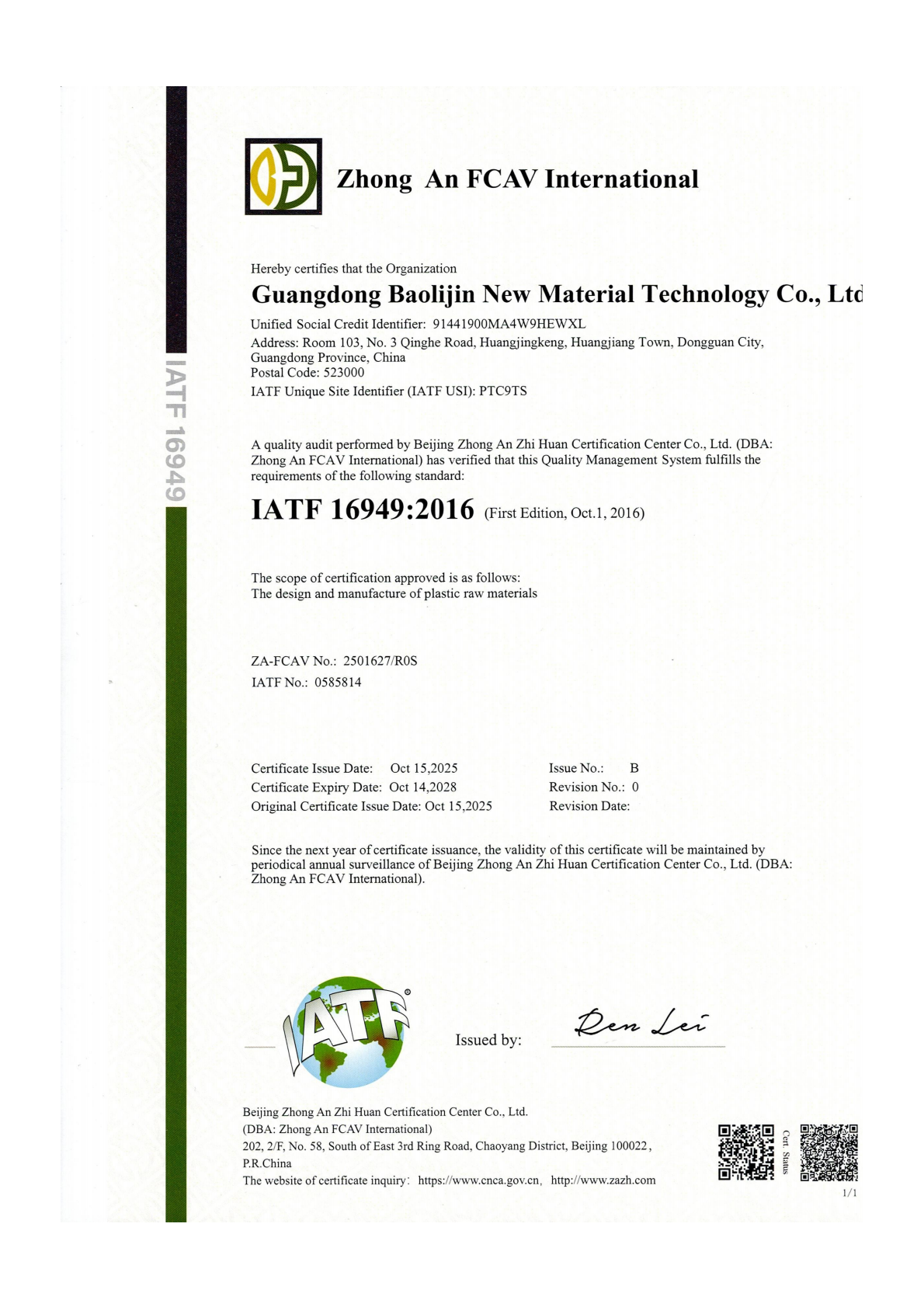
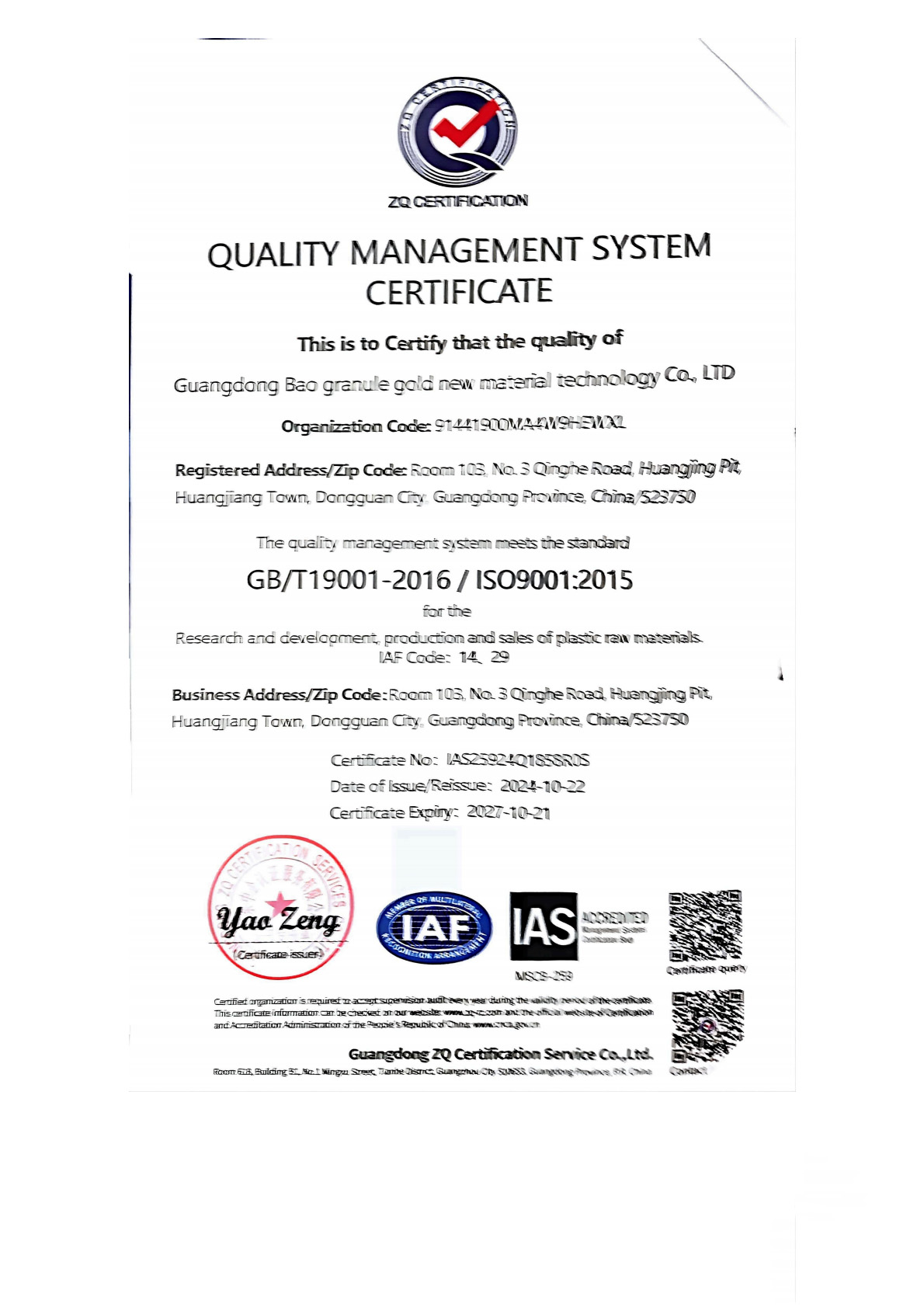
Automotive quality system certification should be verified before mold investment. Polygram holds IATF 16949:2016 certification (Zhong An FCAV no. 2501627/R0S, IATF no. 0585814, issued 15 October 2025, valid to 14 October 2028) and ISO 9001 certification (GB/T 19001-2016/ISO 9001:2015, certificate IAS25924Q1858R0S, issued 22 October 2024, valid to 21 October 2027).
Step 7 - Validate through tooling and sampling
Material design, mold opening and injection molding are handled as one customization scope, which shortens the loop between data sheet and physical part. Quality control is 100% test, and shipment acceptance is by pre-shipment random inspection, so a buyer can align incoming inspection with the supplier's own release criteria rather than duplicating it.
Step 8 - Lock production parameters and the supply plan
Confirm capacity, lead time and material handling before release. Relevant figures for planning are a lead time of 30 days, an annual output of 12,000,000 units, packaging of 20-25 kg per bag (customizable), and remote after-sales support. For high-speed mass production, low fiber float and integrated injection molding of long carbon fiber are the process characteristics that keep part-to-part variation under control.
Use Cases: Where LFT Carbon Fiber Composite Plastic Is Applied in NEV Programs
The most directly documented NEV application is the power battery pack upper cover and protective shell. This component family must provide high-voltage insulation, shock resistance and electrolyte resistance in the same part, and it has been produced for a new energy vehicle Tier1 (ODM) client in China for eight years, from 2018 to 2026, at a scale of 120,000 units per year.
The reported project results are specific and worth reading against the selection steps above:
- Weight: 42% weight reduction compared with the aluminum baseline.
- Cost: 18% cost reduction.
- Compliance: passed UL94 V0 and IP6K9K.
- Field performance: no after-sales cracking or leakage reported.
- Process: integrated injection molding of long carbon fiber, CTE compatible with aluminum at 28 ppm/℃, low fiber float suitable for high-speed mass production.
These outcomes illustrate why CTE compatibility and process stability belong in the specification together with mechanical data. A material can meet a strength target and still fail in service if the thermal expansion match or the molding consistency is wrong. The same LFT carbon fiber composite family is also applied in aerospace, military, low-altitude economy, robotics, semiconductor and sports equipment programs, but the battery pack cover remains the clearest NEV reference case because the full requirement set, insulation, impact and chemical resistance, is documented.
Comparison Table: Matching Component Requirements to Verified Material Data
The table below converts the selection logic into a checkable list. Each row pairs an NEV component requirement with the property to verify, the verified Polygram value, and the evidence a buyer should request.
| NEV component requirement | Property to verify | Verified LFT carbon fiber composite plastic data | Evidence to request |
|---|---|---|---|
| Carry structural load without excessive deflection | Tensile strength and flexural modulus | 350 MPa (ISO 527-2); 30,700 MPa (ISO 178) | Material data sheet stating test standards |
| Resist bending failure in plate-like parts | Flexural strength | 510 MPa (ISO 178) | Flexural test report |
| Survive impact and handling | Izod impact and elongation at break | 40 kJ/m² (GB/T 1843); 7.8% (ISO 527-2) | Impact and tensile test data |
| Reduce weight versus metal assemblies | Density | 1.28 | Material data sheet |
| Tolerate thermal cycling with aluminum structures | CTE compatibility | 28 ppm/℃ in the battery pack cover project | Project validation record |
| Match reinforcement to the load case | Long carbon fiber content | 20-60% (LFT-G grade) | Grade specification and batch certificate |
| Insulate high voltage and resist electrolyte | Component-level electrical and chemical validation | UL94 V0 and IP6K9K passed in the battery pack cover project | Certification test reports |
| Satisfy automotive quality systems | Quality management certification | IATF 16949:2016; ISO 9001 (GB/T 19001-2016/ISO 9001:2015) | Valid certificates and expiry dates |
| Serve medical-adjacent programs from the same site | Medical device quality system | GB/T 42061-2022/ISO 13485:2016, certificate 64625B8031170R0S, valid to 10 March 2028 | Certificate copy |
FAQ
Which certifications should an NEV component buyer verify before placing a material order?
Three certificates are relevant. IATF 16949:2016 is the automotive quality system requirement: Polygram holds Zhong An FCAV no. 2501627/R0S and IATF no. 0585814, issued 15 October 2025 by Beijing Zhong An Zhi Huan Certification Center Co., Ltd. (Zhong An FCAV International) and valid to 14 October 2028. ISO 9001 is held as GB/T 19001-2016/ISO 9001:2015, certificate IAS25924Q1858R0S, issued 22 October 2024 by Guangdong ZQ Certification Service Co., Ltd. and valid to 21 October 2027. The medical device management system certificate under GB/T 42061-2022/ISO 13485:2016 (certificate 64625B8031170R0S, valid to 10 March 2028) matters if the same site is also producing plastic products for medical devices and equipment. Component-level validation is separate: the battery pack cover project passed UL94 V0 and IP6K9K.
What customization capability should be confirmed for a new NEV component program?
The supplier should be able to carry material selection, mold opening and injection molding as one scope rather than three separate vendors. Polygram provides ODM production services and customization covering material selection, mold opening and injection molding, supported by a 10-engineer R&D team, a 4,000 m² production base with 30 employees, and an annual output of 12,000,000 units. Roughly 30% of output is exported to Europe, America and Southeast Asia.
What drives the cost of a carbon fiber composite plastic NEV part?
Three factors dominate: the material itself, where long carbon fiber content can be set between 20% and 60% and the base resin can range from PP to PEEK; the mold, because mold opening is part of the customization scope; and the molding process, where integrated injection molding of long carbon fiber replaces multi-step assembly. As a reference point, the battery pack cover project reported an 18% cost reduction alongside a 42% weight reduction against the aluminum baseline. Buyers should evaluate cost against the full requirement set, since over-specifying fiber loading or resin grade raises cost without improving part performance.
How can engineers validate a grade before committing to tooling?
Order a sample and run it through the intended test regime. Polygram offers customization services including material selection and mold opening with a minimum order quantity of 50 units, and applies 100% test as its quality control approach. Shipment acceptance is handled by pre-shipment random inspection, so incoming inspection can be aligned with the supplier release record. Validating the grade against the actual load case, thermal cycling range and chemical exposure before cutting production tooling is what prevents a late redesign.
What lead time and supply capacity should buyers plan for?
Polygram quotes a 30-day lead time, an annual output of 12,000,000 units, and packaging of 20-25 kg per bag that can be customized to the buyer's handling system. After-sales support is provided remotely. For a new NEV program, the practical sequence is to confirm the grade against the data in this guide, request a sample, and align the injection molding parameters with the supplier before production tooling is released.
Conclusion
Selecting carbon fiber composite plastic for an NEV component comes down to matching verified material data to a defined load case, thermal environment, chemical exposure and compliance requirement. The reference values in this guide, 350 MPa tensile strength (ISO 527-2), 510 MPa flexural strength and 30,700 MPa flexural modulus (ISO 178), 40 kJ/m² Izod impact (GB/T 1843) and 7.8% elongation at break, are only useful when read against the failure mode the part must avoid. CTE compatibility, long carbon fiber loading between 20% and 60%, and process stability under high-speed mass production decide whether the part survives service life.
The battery pack upper cover and protective shell case shows how those factors combine: eight years of production from 2018 to 2026 at 120,000 units per year, a 42% weight reduction and 18% cost reduction against aluminum, UL94 V0 and IP6K9K validation, a CTE of 28 ppm/℃ compatible with aluminum, and no reported after-sales cracking or leakage.
Next step: if you are evaluating a grade for a specific NEV component, request a material sample or a technical data pack against your load case, thermal range and compliance requirements.
Website: www.carbolft.com · Email: baolijin@carbolft.com · WhatsApp: +86 18664191149
Download the product brochure (PDF): Polygram carbon fiber composite plastic brochure
Guangdong Baolijin New Material Technology Co., Ltd., 1st Floor, Building 3, Dongwu Science Park, Qinghe Road, Huangjingkeng Village, Dongguan City, Guangdong Province, China.
Have Questions or Need More Details?
Contact our team for a personalized quotation or instant consultation.
Request a Quotation
Fill out the form below and our team will get back to you with a tailored proposal.
WhatsApp Direct Chat
Prefer to chat in real-time? Message us on WhatsApp for instant assistance & quick answers.
- Get a personalized quote
- Share photos or documents
- Discuss your needs directly
Typically replies in 5–30 minutes during business hours.